

I dont think bumpstops are part of the problem Gary. These guys have new equipment with new technology that sometimes you just can't get into an older car, unless you are willing to make some major changes to it.
Thats not to say an older car wont work - we have guys that come out in our class with older cars and run just as fast as the newer equipment, and challenge for the lead.
Take away bumpstops, then you'll be getting into coil binding and you really dont want to be doing that. You thought bumpstops are hard to deal with, wait till you have to figure coilbinding out - with high dollar coil springs, or changing them every few weeks. That will really seperate the field.
You can gear bumpstops up for a couple of hundred bucks - cheaper if you are a little creative. If you would like some help, dont be afraid to ask.
I might be with you on the crate motor stuff. You shouldnt need to freshen a brand new crate motor, and a rebuild shouldnt be more than the cost of a new crate. Just sayin
Impressive commentary Topper , well put.
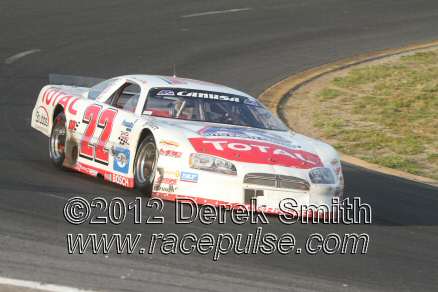
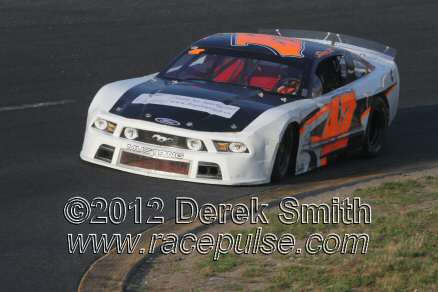
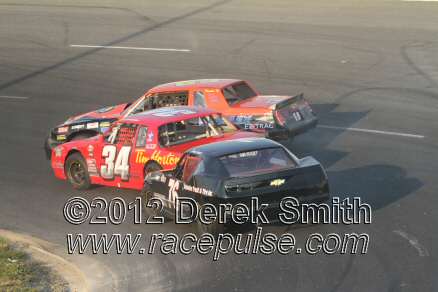
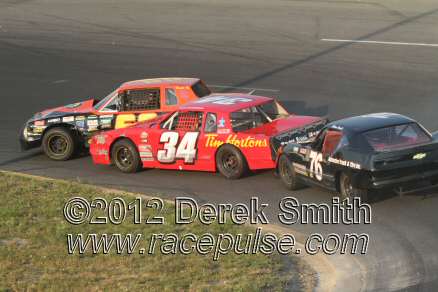
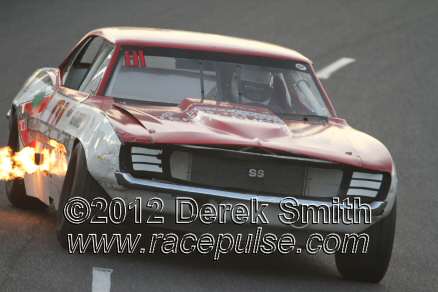
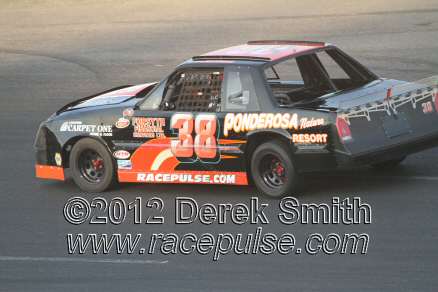
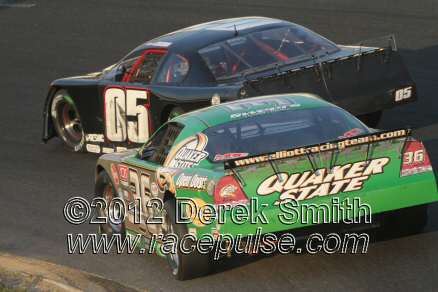
Here are some more samples from Sunset speedway Wednesday July 11.
About 2/3 of the 3300 photos are online on www.racepulse.com -i'll have
more ready soon (including a sequence of the lap 1 lm wreck).



Thanks Glen I did message you.
I am curious to know how some cars are able to maintain higher RPM's and not float the valves like I do. My engine is the one out of my CVM, direct from MacMaster GM, and I did not touch it, and won't unless the rules remain the same for 2013. It seems so stupid to have a great engine program that gets messed up. Why waste the money????
Also, I did replace my valve springs in May, as a preventitive measure, but with stock valve springs, the same that's in the car originally. Could I have installed heavy springs and allowed more RPM...I think so, though I personally could not have done it, but could have made that change without removing the heads or intake. So if someone says their engine has never been rebuilt, they would be telling the truth, but they did not use the stock valve springs that would prevent them going over 6400 RPM.
Thanks again, talk to you soon.
I’m sorry I didn’t make myself clearer yetti69, I wasn’t actually asking how traction control works, just perplexed as how you would make it work on a locked/welded diff and specifically on car 47 (the subject of this discussion) and what the advantage would be.
As I understand it, traction control (in a rear wheel drive vehicle) is designed to direct power to the wheel that has the most weight on it. The earliest form of traction control of course is the limited slip diff which is a purely mechanical system that transfers a relatively small amount of power to the non-slipping wheel.
The subsequent and current forms are electromechanically operated systems (computer controlled) and use a variety of methods to function. Some use the computer controlled engine management system to reduce or suppress spark to one or more cylinders, reduce fuel supply to one or more cylinders or close the throttle, if the vehicle is fitted with drive by wire throttle.
While this is a great idea for the little old lady next door and stops her from having a wreck on an icy road it would hardly seem a great option for car 47 or any other racecar who want/need full power and has the ability to use a locked /welded diff.
Why reduce the motors power output to reduce wheel spin when you can increase the grip by locking the diff.
The above option would by the way require a computerized engine management system and wiring not normally found in a race car of this type and you wouldn’t need a tech to check it, blind Freddy would be able to spot it.
That leaves us with the alternate option that is in popular use and that is to use the cars ABS system which invokes the ABS electronic control unit to apply brake friction to the wheel spinning.
The braking action on the slipping wheel will cause power transfer to the wheel/axle with traction due to the mechanical action within a diff.
Hence my original question, how would it work on a locked diff? The diff is welded and has no way to transfer more power to one side or the other, both axles turn together at all times and therefore have the same amount of power as each other.
I have one final point on this (you just knew I would :D), traction control can not under any circumstances increase grip.
It is only useful and can only be used to decrease the effect of driver error or compensate for a driver's inability to react quickly enough to wheel slip.